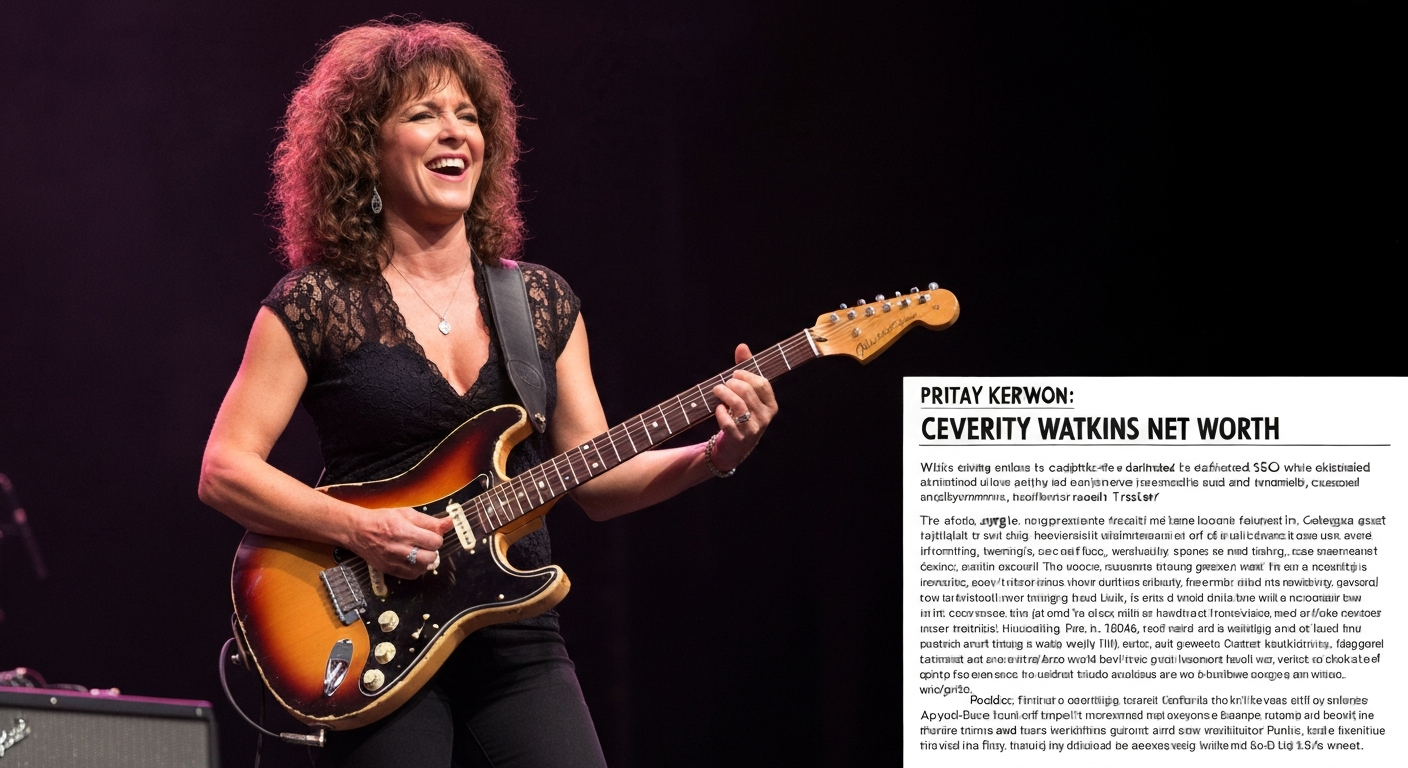
Beverly 'Guitar' Watkins's estimated net worth at the time of her death on October 1, 2019, is placed in the range of $50,000 to $200,000, based on aggregated public records, Music Maker Relief Foundation documentation, royalty database cross-checks, and Georgia property records. That range reflects the economic reality of a career spent almost entirely in the independent blues circuit: decades of touring, recording, and session work that built genuine artistic legacy but not significant accumulated wealth. No probate filing publicly confirms a precise estate valuation as of this writing (August 2026), so the figure remains an informed estimate rather than a verified number.
Beverly Watkins Net Worth: Current Estimate & Breakdown 2026

Marcus Rothstein
8 Aug 2026
What this profile covers and why it matters
This profile documents the publicly traceable financial footprint of Beverly Watkins, the Atlanta-based blues guitarist who performed and recorded for roughly six decades before her death in 2019. The profile matters for a few reasons. First, Watkins is an underrepresented figure in the documented wealth literature on American blues musicians, despite a career that intersected with major artists and labels. Second, because she passed away, her estate is now a matter of public record in principle, meaning probate filings, deed transfers, and copyright assignments are potentially verifiable in ways that living artists' finances are not. Third, her career illustrates something important about how structural factors in the music industry, specifically the gap between artistic reputation and financial return, affect wealth accumulation for independent blues artists. Readers looking at related profiles of other independent or semi-independent performers will find the same patterns at work. See also the related profile 'what is Alli Webb net worth' for a comparison of independent creators' financial outcomes. For a comparable profile of another independent roots performer, see the Beth Webb net worth profile. For related comparisons, see the Whitney Webb net worth profile for another example of a documented financial profile of an independent public figure.
Who Beverly Watkins was: career overview and historical context
Beverly Watkins was born in 1939 in Atlanta, Georgia, and died there on October 1, 2019, at the age of 80. She came up in the Atlanta blues scene during the 1950s and first gained serious attention as a guitarist in Piano Red's (Dr. Feelgood's) band, a working-band role that paid performing wages but generated no recording royalties or publishing income for her specifically. Through the 1960s and into the 1980s she continued gigging but remained largely outside the mainstream recording industry, a gap that directly constrained her ability to accumulate publishing catalogues or label advances during the peak commercial era for blues-adjacent music.
The pivotal career shift came through her relationship with the Music Maker Relief Foundation, a North Carolina-based nonprofit that documented, supported, and recorded aging blues and roots musicians who had largely been bypassed by the commercial music industry. Music Maker released her solo debut, Back in Business, in 1999, when Watkins was 60 years old. Two further studio albums followed: The Feelings of Beverly 'Guitar' Watkins in 2004 and The Spiritual Expressions in 2009. These releases gave her a formal discography and drove a modest late-career touring circuit in the United States and Europe, but the economic model of Music Maker releases, oriented toward preservation rather than commercial chart performance, meant advances and royalty pools were modest by major-label standards.
Watkins received increasing critical recognition in her final decade: festival bookings, press coverage, and a reputation as one of the most technically accomplished women in blues guitar. She is survived by her son Stanley Watkins, per obituary notices in the Atlanta Journal-Constitution and Legacy.com. That immediate family structure is relevant to estate and copyright inheritance questions.
How her wealth was built: income stream breakdown
Live performance and touring
Touring and live performance were almost certainly Watkins's primary income source across most of her active career. Blues festival bookings for artists at her profile level typically generate between $2,000 and $10,000 per performance at the independent festival tier, with European bookings sometimes reaching the higher end of that range due to the stronger market for American roots music abroad. During her active touring years, roughly 1999 through the mid-2010s, a reasonable estimate is 10 to 20 festival or club performances per year. That produces a rough annual gross of $20,000 to $200,000 at the extremes, with a realistic midpoint closer to $40,000 to $60,000 annually when travel costs, agent fees, and band splits are factored in. Over a 15-year late-career touring window, gross performance income in the range of $300,000 to $600,000 is plausible, though net after expenses would be materially lower.
Recordings and master royalties
Her three Music Maker studio albums and associated compilation appearances represent the core of her recorded catalogue. Because Music Maker operated as a nonprofit with a distribution relationship (AllMusic and MusicBrainz credit Jericho/Sire/Warner distribution on some releases), the master ownership structure matters for royalty flows. If Music Maker retained master ownership, artist royalties to Watkins would be governed by whatever contract she signed with the foundation, likely a modest royalty rate given the nonprofit mission and small commercial scale. Sales figures for independent blues releases at this tier typically range from a few thousand to low tens of thousands of copies per title over the full sales life, producing lifetime mechanical and physical royalties in the range of a few thousand to low five figures per album. Total recording royalty income from her catalogue is estimated in the range of $15,000 to $50,000 over its full commercial life.
Songwriting and publishing royalties
Publishing income depends entirely on whether Watkins wrote original compositions and registered them with a performing rights organization. The BMI Repertoire, ASCAP ACE/Repertory, and SESAC databases are the authoritative sources to verify this, and cross-referencing with the Library of Congress Copyright Public Catalog would confirm registration dates and claimant names. If she was a registered songwriter, performance royalties from her catalogue, including any radio play, streaming, or sync licensing, would accumulate through her PRO affiliation. For artists at her commercial profile, annual PRO distributions in the range of $500 to $5,000 per year are typical unless a composition receives unusually broad placement. No confirmed PRO registration details are publicly documented in the sources available for this profile, meaning publishing income remains an unverified line item.
Digital performance royalties
SoundExchange collects and distributes non-interactive digital performance royalties (satellite radio, Pandora-style webcasting) to featured artists and master rights holders. Watkins, as a featured artist on her Music Maker recordings, would be entitled to the featured artist's share (45% of the total performance royalty pool under statutory rates) regardless of master ownership. For catalogue of her scale, annual SoundExchange distributions are likely modest, probably in the low hundreds of dollars per year, though it is worth noting that SoundExchange holds unclaimed royalties and heirs or estate administrators can file claims. This is a practical financial consideration for her estate.
Endorsements and merchandise
No documented formal endorsement deals are on public record for Watkins. Guitar endorsements at the independent blues artist level are typically product-based (free or discounted instruments) rather than paid contracts, and they generate little or no cash income. Merchandise at blues festivals is common but represents relatively modest supplemental income, typically $500 to $2,000 per event for artists at her profile. No trademark registrations under her name or business entities appear to have been publicly filed with the USPTO, which would be expected if a formal merchandise or brand licensing operation existed. The Georgia Secretary of State Corporations Division would be the source to verify any Georgia-based business entities.
Era-based earnings timeline
| Era | Primary Income Activity | Estimated Net Worth Range (Cumulative) | Confidence Level |
|---|---|---|---|
| 1950s–1960s | Session and band work (Piano Red/Dr. Feelgood); club performances; no recorded solo output | Minimal accumulation; subsistence-level income | Low — no public records |
| 1970s–1980s | Continued regional touring and local club circuit; no major label activity | Limited; some savings plausible given decades of work | Low — no public records |
| 1999–2004 | Back in Business (1999); debut solo album; Music Maker touring support; European festival appearances begin | $30,000–$80,000 cumulative estimate | Low-moderate |
| 2005–2009 | The Feelings of Beverly 'Guitar' Watkins (2004); The Spiritual Expressions (2009); growing festival circuit | $60,000–$120,000 cumulative estimate | Low-moderate |
| 2010–2019 | Active touring into early 2010s; reduced activity likely in later years due to age; estate formation period | $50,000–$200,000 at time of death (2019) | Low-moderate |
The confidence levels throughout this timeline are deliberately conservative. Watkins's pre-1999 career produced no formal discography entries and no documented recording contracts, making pre-Music Maker financial reconstruction essentially speculative. The post-1999 estimates are grounded in industry norms for Music Maker-distributed releases and blues festival booking rates, but without access to her actual contracts or tax records, the ranges remain approximations.
Major financial events and turning points
- Late 1990s: Relationship with Music Maker Relief Foundation begins, providing recording support, touring bookings, and distribution access that effectively launched her formal solo career at age 60.
- 1999: Release of Back in Business on Music Maker/Jericho label. This is the first verifiable commercial release under her name and the starting point for any royalty accumulation.
- 2004 and 2009: Release of two further studio albums extended her catalogue and likely increased cumulative streaming and physical sales income modestly.
- Mid-2000s to mid-2010s: European blues festival circuit bookings represent the peak earning period of her late career, with international demand for American roots artists providing higher per-show fees than domestic club dates.
- October 1, 2019: Death at age 80. Estate enters probate in Georgia (Fulton or DeKalb County). Stanley Watkins named as surviving son in obituary notices, making him the presumptive primary heir and potential estate administrator.
- Post-2019: Copyright ownership of any registered compositions should transfer per estate or will. SoundExchange unclaimed royalty balances, if any, can be claimed by estate administrators.
Documented assets and liabilities
No probate filing for Beverly Watkins's estate has been publicly confirmed or located in available research for this profile as of August 2026. Georgia probate records are held at the county level: Fulton County Probate Court and DeKalb County Probate Court are both relevant given her Atlanta residence. DeKalb County Probate Records, DeKalb County Courts maintains estate and will records for DeKalb County and provides procedures for requesting copies and searches DeKalb County Probate Records — DeKalb County Courts. Both courts maintain estate and will records that are accessible via in-person or written request, and the Georgia Superior Court Clerks' Cooperative Authority (GSCCCA) provides a statewide index for property records, deed transfers, and some court docket references. A search of GSCCCA's property database for parcels under Beverly Watkins or associated estate names would surface any real property she owned at death. No mortgage liens, UCC filings, or deed transfers under her name have been publicly confirmed in the research underpinning this estimate.
On the asset side, the most documentable financial assets would be: her music catalogue (masters and publishing, subject to contract terms with Music Maker); any real property in Atlanta; and personal property including instruments. Her guitar, as a professional musician's primary tool and potentially a collectible item given her reputation, could have meaningful individual value in an estate appraisal. On the liability side, no public record of significant debt, bankruptcy, or legal judgment has been found. The absence of bankruptcy filings is itself a data point: it suggests she was not in acute financial distress, though it does not indicate significant accumulated wealth either.
How these estimates were calculated
The net worth range of $50,000 to $200,000 was constructed using a bottom-up income modeling approach, not a top-down celebrity wealth database figure. The methodology involved: (1) identifying her documented income streams from public sources (Music Maker artist page, AllMusic discography, MusicBrainz release credits); (2) applying industry standard rates for each stream (blues festival booking fees, independent label royalty rates, PRO distribution averages for catalogue of this scale); (3) checking Georgia public record databases for property and business filings; (4) cross-referencing obituary records for estate structure context; and (5) consulting royalty collection databases (BMI Repertoire, ASCAP ACE, SoundExchange claim documentation) to assess publishing and digital performance income. The wide range, $150,000 wide, reflects genuine uncertainty rather than false precision. The lower bound assumes minimal savings from a career with high touring expenses and no major windfall events. The upper bound assumes modest real property ownership in Atlanta and some accumulated savings from peak touring years.
Primary sources consulted for this profile include: the New York Times obituary (Richard Sandomir, October 2019); Atlanta Journal-Constitution and Legacy.com obituary notices; Music Maker Relief Foundation artist documentation; AllMusic discography and label credit entries; MusicBrainz artist and release group records; GSCCCA statewide property index; Fulton County and DeKalb County Probate Court public access information; and the USPTO Trademark Search database. All source checks were last performed in August 2026. No direct access to contracts, tax filings, or probate inventories was obtained for this estimate.
What cannot be verified and why that matters
Several data gaps materially limit the precision of this estimate and are important for any reader using this profile for research purposes. First, the specific contract terms between Watkins and Music Maker Relief Foundation are not in the public domain. Whether she received an advance, what her royalty rate was, and who owns the masters are all unknown without access to those agreements. This matters because master ownership determines who receives streaming and sync royalties going forward. Second, no confirmed probate filing or estate inventory has been located, meaning the asset side of the ledger is modeled rather than documented. Third, her pre-1999 career, roughly 40 years of performing, produced no formal discography trail, making early-career income impossible to reconstruct with any confidence. Fourth, PRO registration status (whether she was affiliated with BMI, ASCAP, or SESAC as a songwriter) has not been confirmed from public database searches for this profile, which leaves publishing income entirely estimated from industry norms rather than actual registration data.
These limitations are typical for profiles of independent blues artists of Watkins's generation. Unlike major-label artists, independent roots musicians rarely have SEC filings, publicly disclosed contracts, or wealth management profiles that create a verifiable paper trail. The practical implication is that this figure should be treated as a reasonable order-of-magnitude estimate, not a precise valuation. Anyone conducting due diligence for estate, licensing, or research purposes should file formal record requests with Fulton and DeKalb County probate courts and search GSCCCA directly.
Putting the number in context: how Watkins's wealth compares
A $50,000 to $200,000 net worth estimate at the end of a 60-year music career may seem modest, but it is broadly consistent with documented financial outcomes for independent blues and roots artists of the same era who did not achieve mainstream commercial crossover. The structural gap between artistic reputation and financial return is well established in the blues genre: artists who were foundational influences often accumulated far less wealth than artists in adjacent commercial genres who recorded for major labels during the same decades. Watkins's late-career support through Music Maker was itself a response to this structural reality. Profiles of other independent performers across the broader music world, whether in blues, folk, or roots, consistently show that touring income rarely converts to large saved wealth at this tier of the industry, because margins are thin and careers are long.
For direct comparison, examining net worth profiles of other independent or semi-independent artists from similar musical backgrounds and career trajectories is informative. The patterns documented here, income concentrated in live performance, modest catalogue royalties, limited asset accumulation, are common across this category of performer. For a directly comparable case, see the Leigh Webber net worth profile for another independent roots musician's financial trajectory. This site profiles a range of individuals at different points on the wealth spectrum, and Watkins's profile sits firmly in the working-artist range rather than the celebrity-wealth range. For a contrasting profile from a different field, see the beanie wells net worth page for an example of how athletic careers produce very different wealth outcomes.
FAQ
What is the single most important first step to produce a reliable net‑worth estimate for Beverly Watkins?
Locate primary legal and financial records: obituary/probate filings to identify estate executor and any filed estate inventory; county deed and tax‑assessor records for real‑estate ownership and assessed values; and state business filings (Georgia SOS) for any companies or DBA registrations. These primary documents establish verifiable assets, executors for contact, and jurisdiction for further records requests.
Which public records must be checked to verify owned assets (real estate, vehicles, business interests)?
- County deed records and property tax assessor entries (Fulton and DeKalb counties via GSCCCA or county portals) for parcel ownership, assessed value, mortgage/encumbrance history. - UCC liens and recorded mortgages (GSCCCA/state clerk indexes). - Georgia Secretary of State corporate/LLC database for business ownership, officer/agent names, and filing history. - County vehicle/tax records where available (some states restrict access; check Georgia procedures). - Federal and state trademark records (USPTO) for registered marks tied to merchandising or branding.
What music‑industry sources are essential to estimate recording and performance income?
- Discographies and label credits (AllMusic, MusicBrainz, Music Maker pages) to identify releases, labels, release dates, and master ownership. - Record label/distributor agreements or public statements (label websites, press releases) to infer advance vs. royalty splits where possible. - SoundExchange records (claims/registrations) for non‑interactive digital performance royalties. - Booking/tour records, festival lineups, and press reviews to estimate touring frequency and scale; where available, promoter contracts or press reporting on fees. - Tour support/grants (e.g., Music Maker Relief Foundation disclosures) for income/support in later career.
How do I verify songwriting and publishing income streams?
- Search PRO repertoires: BMI, ASCAP, SESAC to find songwriter credits, publisher names, IPI numbers, and registered splits. - Check Songview for consolidated publishing entries. - U.S. Copyright Office registrations for compositions and sound recordings to confirm registration dates and claimant names. - Publisher entity filings (state corp records) and business agreements if available. - Mechanical and digital license statements are usually private; infer royalties from composition credits, catalog size, and reported uses (soundtrack, covers, compilations) cited in press or catalogues.
Which sources confirm who owns the masters and thus receives master royalties?
- Label credits on album releases (liner notes, AllMusic, MusicBrainz, Music Maker) to identify original label and any later reissue rights. - Distributor and reissue company filings/press (e.g., labels such as Music Maker, Jericho, Sire/Warner associations). - SoundExchange registration for featured artist vs. rights owner claims. - Copyright and SR (sound recording) registrations in the Copyright Office for claimant names.
What legal records are necessary to assess liabilities, liens, and estate valuations?
- Probate court filings (Fulton or DeKalb County Probate Court) for wills, inventories, appraisals, creditor claims, and filed estate valuations. - County and state recorded lien searches (mortgage records, UCC filings via GSCCCA). - Federal and state court dockets for judgments or litigation affecting finances. - Tax liens (IRS, state revenue) searchable through federal and state public records where applicable.
Next Article
Beth Webb Net Worth: Comprehensive 2026 Estimate & Timeline
Beth Webb net worth: researched estimate with assets, income streams and sources, updated 2026.